

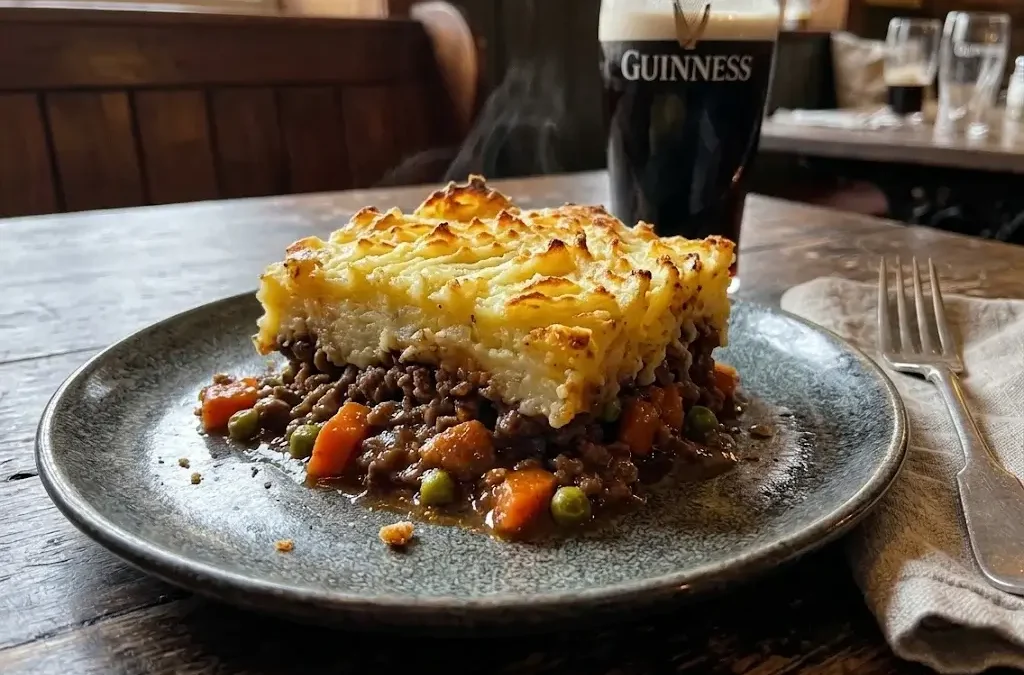
This Gordon Ramsay steak and Guinness pie recipe has no stock in it. Floured braising steak and whole shallots simmer for 90 minutes in a pint of Guinness, with tomato purée and herbs. The flour from the beef coating thickens the sauce. Most steak pies start with stock, carrots and a gravy built over several hours. Here the Guinness is the only liquid, so the filling tastes dark, savoury and malty rather than sharp. Because the filling is fully cooked before it goes under the lid, the bake is only 15 to 20 minutes.
I’ve made it four times, and everyone who has eaten it has been happy with it. This page gives you the method in my own words, timings that add up honestly, a real cost per portion, fixes for the problems that most often spoil a pie, and storage advice that follows UK guidance.
Where this recipe comes from
This is based on Gordon Ramsay’s beef and Guinness pie (often titled steak and Guinness pie) in Great British Pub Food (2009). I follow his approach:
- Braising steak cut into 2.5cm cubes and tossed in seasoned flour.
- Tomato purée stirred in before the liquid.
- 500ml of Guinness, 350g of shallots, thyme, bay and garlic simmered with the beef for about 1½ hours, with no stock.
- A shortcrust lid glazed with egg yolk and water.
- A 200°C oven for 15 to 20 minutes.
The step timings around the simmer and bake, the cost, the troubleshooting and the storage advice are my own additions for UK home cooks. So are the cooling stage, the steam vent, the 5-minute rest and the 60ml water top-up for a UK can.
How I checked this page
- Cooked at home: I’ve made this pie four times in my own kitchen.
- The recipe: I compared the ingredients and method step by step across published copies: Elaine Yau’s blog (March 2009), The Hungry Duchess, “Welcome to my LA World” (April 2010) and Lea & Jay (March 2011), plus the ingredient list on Copy Me That. These are blog copies, not a publisher’s reprint, and I did not find an official reprint of this recipe online.
- The timings: I added up each step. The 90-minute simmer and the 15 to 20 minute bake come from the copies. Browning, cooling and assembling are my own estimates, so go by the visual cues.
- The costs: priced from Tesco’s online listings in November 2026, with a price tracker for the Guinness and the Sainsbury’s comparison. Prices change, so treat them as a guide.
- The storage advice: it follows Food Standards Agency (FSA) and NHS guidance on cooling, fridge life, freezing and reheating.
- The nutrition: a rough estimate built from Tesco label values, not a lab figure.
Why the long, gentle simmer works
Braising steak is full of connective tissue. Cooked slowly in liquid, that collagen dissolves into gelatin, the fibres fall apart, and the sauce gains body. The same source notes that higher temperatures squeeze more juice out of the meat. So the pan stays at a gentle simmer, not a rolling boil. The flour you toss the beef in does a second job and thickens the liquid.
The Guinness needs handling with some care. Cooks warn that cooked beer can turn especially bitter, and reducing it too far gets unpleasant. This recipe sidesteps that. The pan is covered, so little liquid boils away and the stout never becomes a concentrated reduction. Shallots add sweetness to balance what bitterness remains. Chef Paul Flynn makes the same point in a Guardian feature, saying a sweet element is the key to cooking with Guinness.
Gordon Ramsay steak and Guinness pie recipe ingredients
For the filling
- 750g lean braising steak (skirt, or chuck), cut into 2.5cm cubes
- 4 tbsp plain flour
- Salt and freshly ground black pepper
- 4 tbsp olive oil
- 1 tbsp tomato purée
- 500ml Guinness (one 440ml can plus 60ml water)
- 350g shallots, peeled
- A few sprigs of thyme
- 2 bay leaves
- 2 garlic cloves, peeled and chopped
For the topping
- 500g shortcrust pastry (one standard block)
- 1 egg yolk beaten with 1 tbsp water, to glaze
Dish: 20cm round pie dish, 5 to 7cm deep.
Method
- Coat the beef. Toss the cubes in the flour with a good pinch of salt and pepper until every piece is lightly coated.
- Brown. Heat the oil in a large, heavy pan or flameproof casserole with a lid, over high heat. Brown the beef in two batches until golden, about 10 minutes in all. Crowding the pan makes it steam, so don’t tip it all in at once.
- Add the purée. Stir in the tomato purée and cook for 1 minute.
- Simmer. Add the Guinness (with the water, if you’re using a can), the shallots, garlic, thyme and bay. Season lightly, scraping up the browned bits. Bring to the boil, then cover and turn down to a gentle simmer for 1½ hours. It’s ready when a piece of beef gives easily to a fork and the sauce coats the shallots.
- Cool. Fish out the bay leaves and the thyme stalks, then taste and adjust the seasoning. Leave the filling to stand for 20 minutes while you heat the oven to 200°C (180°C fan, gas mark 6) and roll out the pastry.
- Build. Spoon the filling into the dish. Lay the pastry over, press the edge down and trim it, leaving a 1 to 2cm overhang. Cut a small steam vent in the middle and brush with the egg glaze.
- Bake. Stand the dish on a baking tray and bake for 15 to 20 minutes until the pastry is golden. Check the filling is steaming hot in the centre.
- Rest. Leave the pie for 5 minutes before serving, because the filling is very hot.
Allergens and swaps
Allergens: cereals containing gluten (wheat in the flour and pastry, barley in Guinness) and egg (the glaze). Brand labels vary, so check the pastry. Jus-Rol’s shortcrust is labelled suitable for vegans, but an all-butter pastry would add milk. Worcestershire sauce isn’t in this recipe. If you add it to taste, note that the FSA lists it among foods that can contain fish.
Swaps
- Beef: chuck works in place of skirt, as the Lea & Jay copy notes.
- Pastry: puff instead of shortcrust is an accepted option in the copies. Cool the filling before it goes under puff.
- Which Guinness: use Draught. Cook’s Country calls Extra Stout too bitter for stew.
- Alcohol-free: use the same amount of fresh beef stock, as Good To Know suggests for its own pie. You lose the roasted-barley note.
How the timings add up
| Stage | Time |
|---|---|
| Prep (cubing beef, peeling shallots) | 20 min |
| Browning the beef | 10 min |
| Purée, then liquid and bringing to a simmer | 10 min |
| Simmering, covered | 90 min |
| Cooling the filling (oven heating and pastry rolling happen now) | 20 min |
| Assembling | 10 min |
| Baking | 15 to 20 min |
| Resting | 5 min |
| Total | 180 to 185 min, about 3 hours |
The oven heats while the filling cools, so that adds no extra time. The simmer and bake come from the recipe copies. The other stages are my estimates.
What does it cost?
Based on Tesco’s online listings at the time of writing:
| Item | Amount used | Approx. cost |
|---|---|---|
| Tesco Stewing Steak, £11.12/kg (£4.45 per 400g) | 750g | £8.34 |
| Tesco shallots, £3.38/kg (£1.35 per 400g) | 350g | £1.18 |
| Guinness Draught, 4 × 440ml at £5.65 | 1 can | £1.41 |
| Jus-Rol Shortcrust Block, 500g | 1 block | £1.55 |
| Total | £12.48, about £3.10 per portion |
Oil, flour, tomato purée, garlic, herbs, the egg yolk and seasoning aren’t priced. A second Tesco page showed the beef at £4.59 and the pastry at £1.40, so expect small differences.
There’s no honest budget tip here. The beef is 67% of the bill, and Tesco’s stewing steak was the cheapest diced beef I found. Sainsbury’s was £6.00 for 500g, or £12.00/kg, on a price tracker.
Tips for the best pie
- Don’t hurry the simmer. Ninety minutes is the copies’ figure. If the beef still resists a fork, keep going at a gentle simmer rather than turning the heat up.
- Keep the lid on. It stops the Guinness reducing into something bitter.
- Halve any large shallots. They then cook at the same pace as the smaller ones.
- Cut a steam vent. Good To Know recommends one for a lid-only pie, so steam escapes instead of softening the pastry.
- Let the filling stand before topping. Super Golden Bakes advises a thick, cooled filling for puff-topped pies.
- Don’t cover the baked pie. Trapped steam softens the crust.
If it goes wrong
- Tough beef: it was boiled too hard or stopped too early. Keep it at a gentle simmer until a cube gives easily to a fork.
- Bitter sauce: the stout was Extra Stout, or the liquid reduced too far. Next time use Draught and keep the lid on. To rescue this batch, stir in a little redcurrant jelly or maple syrup.
- Watery filling: simmer it uncovered, stirring, until it coats the back of a spoon.
- Soggy or slumped lid: hot steam met the pastry with nowhere to go. Let the filling stand first, cut a vent, and don’t cover the baked pie.
- Golden pastry, lukewarm middle: the filling went in cold. Cover with foil and keep baking until it’s steaming hot throughout.
Make ahead, store, freeze and reheat
- Make ahead: the filling keeps a day, which the copies confirm. Cool it quickly and chill it, covered, at 5°C or below. Assemble on the day.
- Cold filling bakes longer. I couldn’t find a tested time, so go by the probe, not the clock.
- Cooling: get leftovers into the fridge or freezer within one to two hours of cooking, as the FSA advises. Smaller, shallow containers cool faster.
- Fridge: eat within 2 days (48 hours). If you made the filling ahead, count the two days from when it was first cooked.
- Freezer: freeze cooled portions at -18°C for up to 2 months. NHS Forth Valley says 2 months, and some sources say 3, so I use the shorter. Defrost in the fridge and eat within 24 hours.
- Reheat: only once, until it’s steaming hot all the way through. UK guidance quotes either 70°C for 2 minutes or 74°C, and I use the higher figure. A pie baked from a cold filling has had its one reheat, so don’t heat the leftovers again.
What to serve with it
Mashed potato and vegetables are the classic partners, and the Ramsay copy suggests exactly that. Peas, green beans, buttered cabbage and a jug of gravy all work well alongside.
Nutrition (estimate)
Filling alone comes to roughly 495 kcal per portion (serves 4), from Tesco label values for the beef, shallots and Guinness, plus standard figures for oil and flour. Pastry adds about 105 kcal per portion for every 100g you use. A 200g lid brings it to about 700 kcal. The whole 500g block brings it to about 1,020 kcal. The whole-block total of about 4,085 kcal sits within roughly 10% of the Delish Sides page, whose 750 kcal per sixth implies about 4,500 kcal. Egg glaze, tomato purée and garlic aren’t counted.
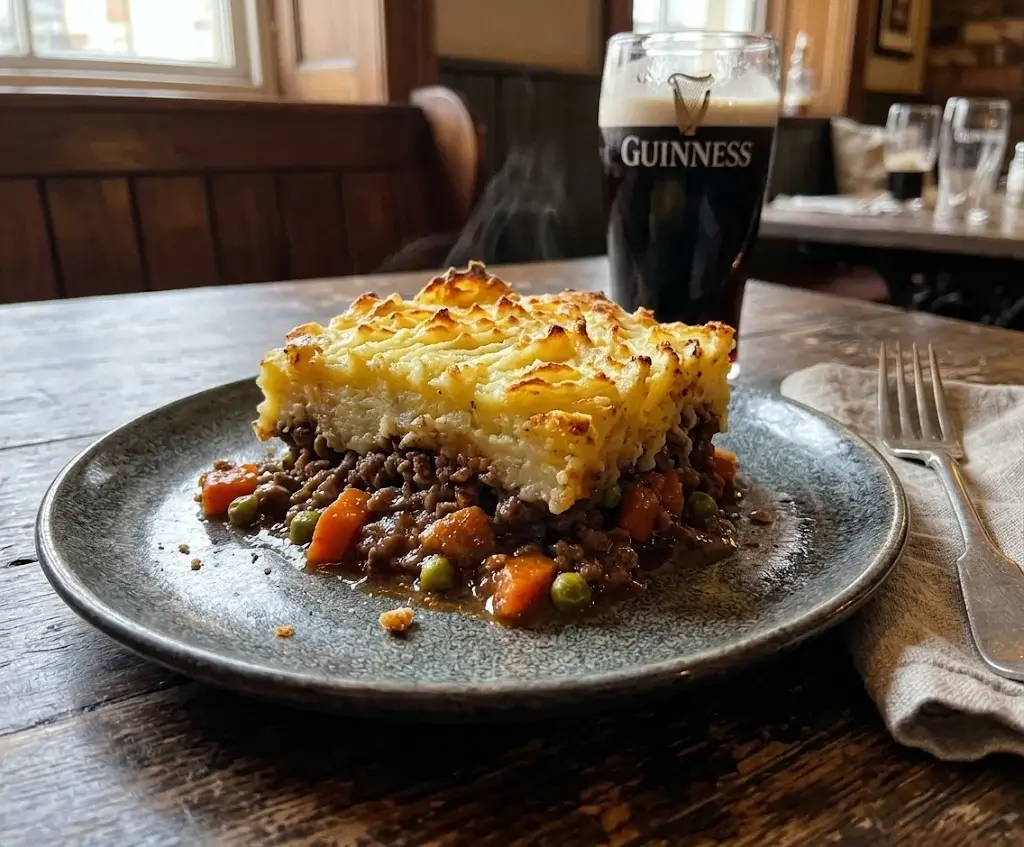
Gordon Ramsay Steak and Guinness Pie
Braising steak and shallots simmered 90 minutes in Guinness with tomato purée, no stock, under a glazed shortcrust lid. Baked 15 to 20 minutes.
Ingredients
Tap to tick off- Filling
- Lid
Method
-
Toss the beef cubes in the flour with salt and pepper until lightly coated.
-
Heat the oil in a large lidded pan over high heat. Brown the beef in two batches, about 10 minutes in all.
-
Stir in the tomato purée and cook for 1 minute.
-
Add the Guinness (and water), shallots, garlic, thyme and bay. Season lightly. Bring to the boil, cover and simmer gently for 1½ hours, until the beef gives easily to a fork.
-
Remove the bay and thyme stalks. Leave the filling to stand for 20 minutes while you heat the oven to 200°C (180°C fan, gas mark 6) and roll out the pastry.
-
Spoon the filling into the dish. Cover with pastry, trim leaving a 1 to 2cm overhang, cut a steam vent and brush with the egg glaze.
-
Bake on a tray for 15 to 20 minutes until golden and the filling is steaming hot in the centre.
-
Rest for 5 minutes, then serve.
Recipe notes
Use Guinness Draught, not Extra Stout. Contains gluten, egg, and may contain milk depending on the pastry. Calories are an estimate: they change with how much of the 500g pastry you use (about 105 kcal per portion per 100g). Reheat once only until steaming hot throughout (74°C).

1 Comment