

This Gordon Ramsay puff pastry recipe is a rough puff: flour, butter, salt and water, with no butter block to wrap and roll. A typical version such as Tesco’s uses 200g of butter to 250g of flour and makes about 530g. Here the butter matches the flour at 250g each, it is rubbed in loosely so that lumps stay visible, and the dough gets just two folds. BBC Good Food’s copy puts the yield at 700g and the work at 10 minutes. With the two chills it takes about an hour, and a batch costs about £2.26 at Tesco.
I have made it at home 3 times, and everyone who ate it enjoyed it. The step that matters most is also the one the recipe stresses: stop rubbing and rolling while the butter still shows as streaks, because that butter is what makes the layers.
This page gives the exact quantities and method, a timings table that adds up, a Tesco cost breakdown, fixes for five common failures, storage limits that follow Food Standards Agency guidance, and a recipe card.
Where this recipe comes from
This is based on Gordon Ramsay’s rough-puff pastry in Gordon Ramsay’s Just Desserts (2001), which BBC Good Food also carries under his name. I follow his approach:
- 250g strong plain flour, 250g butter, 1 tsp fine sea salt and about 150ml cold water.
- Butter at room temperature but not soft, rubbed in loosely so that pieces stay visible.
- Two-thirds of the water first, with more added only if the dough needs it.
- A 20-minute chill, then a roll in one direction only to about 20 x 50cm, a fold in three, a quarter turn, a second roll and fold, and a final chill of at least 20 minutes.
The timings, cost, troubleshooting and storage advice are my own additions for UK home cooks.
Two things to know about the copies. None of the ones I read names a book or a year, so I cannot confirm from them that this is the text printed in Just Desserts, which Quadrille first published in 2001. And the BBC Good Food version is a recipe for dough only, so it has no oven temperature and no serving count.
How I checked this page
- Cooked at home: I’ve made this pastry 3 times in my own kitchen.
- The recipe: I compared quantities, method order, folds and rests across four copies of the BBC Good Food text (Recipe Thing, The Skillful Cook, Recipe Cart and TF Recipes). I read it through those copies, not on bbcgoodfood.com itself. They share one source, so their agreement shows the text was copied faithfully, not that it was checked independently. Lifehacker Australia lists the same four quantities.
- The timings: I added up each step. The two chills come from the copies. The copies list 10 minutes of work in total, which cannot cover two 20-minute chills, so I treated it as the mixing time and estimated the rolling and folding at 10 minutes.
- The costs: Priced from Tesco’s online listings in November 2026, with the flour and butter cross-checked against the Trolley price tracker. Prices change, so treat them as a guide.
- The storage advice: The raw-dough warning, cooling, defrosting and reheating rules follow FSA guidance. The FSA and NHS give no figure for homemade pastry dough, so the fridge and freezer limits are the most cautious ones I found from published bakers.
- The nutrition: A rough estimate built from Tesco label values, compared with one published figure for a different recipe that uses the same weights of flour and butter.
Why the butter streaks and the chilling matter
The lift. Rough puff has no yeast or raising agent. In the oven, the water in the dough and in the butter turns to steam, and the steam pushes the layers apart. Butter is only about 17% water, according to pastry writer Joe Pastry, which fits Tesco’s label of at least 82% milk fat. The fat does the separating and the water does the lifting.
Why lumps beat a smooth dough. Rough puff skips the butter block of classic puff and works the butter in as pieces instead. King Arthur describes them as large, leaf-like shards, and Dorie Greenspan notes that rough puff needs half as many roll-outs and turns as classic puff, and gives fewer layers. If the butter blends into the dough, there are no pockets left to hold steam. The layers then merge into a chewy, flat texture instead.
Why the temperature is “not soft”. Delicious magazine warns that overly cold, hard butter can break through the layers when you roll, which makes the pastry greasy and uneven. Food52’s hotline answer says dough that has been left warm or overhandled leaks butter and fails to puff. That is why the recipe asks for butter that has lost its chill but still holds its shape, and why it chills the dough twice.
Why it rests. King Arthur says a brief chill lets the gluten relax, which makes rolling easier. If the dough springs back or shrinks, a 5 to 10 minute chill sorts it out.
Why one direction and straight edges. The copies ask for this without giving a reason. Delicious says uneven rolling and folding is a cause of uneven rise, so I read it as a way to keep the layers level.
Gordon Ramsay puff pastry recipe ingredients
- 250g strong plain flour (sold as strong white bread flour), plus a little for the work surface
- 1 tsp fine sea salt
- 250g butter, at room temperature but not soft
- About 150ml cold water
The copies don’t say whether the butter is salted or unsalted. I priced unsalted, so the 1 tsp of salt is the only salt in it.
Method
1. Rub in the butter.
Sift the flour and salt into a large bowl. Break the butter into small chunks, add them and rub them in loosely with your fingertips. Stop while you can still see pieces of butter. It should not look like breadcrumbs.
2. Add the water.
Make a well in the middle and pour in about two-thirds of the 150ml of water. Mix to a firm, rough dough, adding more water only if it won’t come together.
3. Chill.
Cover with cling film and chill for 20 minutes.
4. Shape.
Tip the dough onto a lightly floured surface, knead it gently and shape it into a smooth rectangle.
5. Roll.
Roll in one direction only, to about 20 x 50cm, which is roughly three times the width you started with. Keep the edges straight. The butter should still show as streaks, giving a marbled look.
6. Fold and turn.
Fold the top third down to the centre, then fold the bottom third up over it. Give the dough a quarter turn and roll it out to three times its length again. Fold it the same way once more.
7. Chill again.
Cover and chill for at least 20 minutes before rolling out for use.
One copy, The Skillful Cook, suggests repeating the roll-and-fold pair once more for extra layers. The BBC text stops after two folds, so the recipe card keeps to that.
Allergens and swaps
Allergens:
- Cereals containing gluten. Tesco’s strong white flour is wheat flour, with wheat marked in bold on the label.
- Milk. From the butter.
Brand labels vary, so check yours. As written, the pastry is neither gluten-free nor dairy-free. No tested gluten-free or dairy-free version of this recipe turned up in my research, so I can’t offer one.
Swaps:
- Flour: Other rough puff recipes use plain flour, including Tesco’s. This recipe is written for strong flour, so I’ve kept that.
- Butter: Salted butter works as a swap, but it will make the dough saltier, since 1 tsp of salt is already in.
- Food processor: The Skillful Cook says to pulse the flour, salt and butter until the mixture just starts to clump, then bring it together by hand and carry on from the first chill.
How the timings add up
| Step | Time |
|---|---|
| Weigh, sift, rub in the butter, add water and mix | 10 min |
| First chill | 20 min |
| Knead, roll, fold, turn, roll, fold | 10 min |
| Second chill (minimum) | 20 min |
| Total | 60 min (1 hr) |
Hands-on time is 20 minutes and chilling is 40. Nothing runs in parallel, but the chills are the time to wash up or prepare your filling. The two chills come from the copies. The 10-minute figures are my estimates, and the copies’ single 10-minute listing is not used in the total.
What does it cost?
Based on Tesco’s online listings in November 2026:
| Ingredient | Tesco price | Amount used | Cost |
|---|---|---|---|
| Tesco Strong White Flour, 1.5kg | £1.45 (£0.97/kg) | 250g (£1.45 ÷ 6) | £0.24 |
| Tesco English Unsalted Butter, 250g | £1.99 (£7.96/kg) | 250g, the whole pack | £1.99 |
| Saxa Fine Sea Salt, 350g | £1.90 (£5.43/kg) | 1 tsp, about 5g (my assumption) | £0.03 |
| Total | £2.26 |
At 700g of pastry that is £2.26 ÷ 7 = about 32p per 100g. At 650g it is about 35p. Water, flour for dusting and cling film aren’t priced.
The flour was £1.40 on a Tesco snapshot and on Trolley, and £1.45 on the page I opened, which moves the batch by 1p. One Tesco butter page showed £1.85 against £1.99 on two others. At £1.85 the batch would cost £2.12. Butter is about 88% of the bill. I’m not offering a saving tip: the recipe needs the full 250g, and I didn’t price ready-made pastry, so I can’t claim this beats it.
Tips for the best pastry
- Keep the butter in visible lumps. Rub in loosely and stop early. Smooth dough means the butter has blended in.
- Add the water gradually. Delicious advises adding just enough to bring the dough together, since extra water and handling build gluten and toughen it. Start with the two-thirds the recipe gives.
- Use as little flour as you can on the board. Brush off any loose flour before folding.
- Roll in one direction and keep the corners square. A ruler or palette knife helps with the edges.
- Chill shaped pastry before it goes in the oven. Cook’s Illustrated found 15 to 30 minutes in the fridge firms the butter and stops it melting and leaking too fast.
- Cut with a sharp knife. A dull blade pinches the edges shut and stops the layers rising. Keep egg wash off the cut sides for the same reason.
If it goes wrong
- Butter leaks or the pastry is greasy. The dough got too warm or was overhandled, or the butter was so cold it broke through the layers. If butter starts to seep while you roll, dust the spot lightly with flour and chill the dough. On a warm day, chill for longer between folds.
- It doesn’t puff. The dough warmed up, the layers were crushed by over-rolling, or the oven wasn’t hot enough. Chill, roll gently and follow the oven temperature of the recipe you are baking.
- Tough, not flaky. Too much water, too much flour worked in, or too much handling. Next time add only what is needed and don’t re-roll scraps repeatedly.
- Uneven rise. The rolling or folding was lopsided, the edges were squashed by a blunt knife, or egg wash ran down the cut sides. Square the corners and use a sharp blade.
- The dough fights back or shrinks. The gluten is tight. Chill for 5 to 10 minutes and roll again.
Make ahead, store, freeze and use
- Raw dough: The FSA says not to eat flour products such as pastry and doughs that haven’t been cooked thoroughly. Wash your hands and surfaces after handling.
- Fridge: The copies give no make-ahead advice. Better Homes and Gardens Australia says rough puff can be made up to 2 days ahead and kept in the fridge, so I use 2 days. Wrap it well and keep the fridge at 5°C or below, as the FSA advises.
- Freezer: King Arthur and The Woks of Life both say up to 1 month, well wrapped. Other sites say 2 or 3 months. I use the shortest, which is a quality limit and not a safety one. The FSA says homemade food should be frozen as soon as possible.
- Defrost: Thaw in the fridge overnight. The FSA says defrosted food should be used within 24 hours and not refrozen. Cook’s Illustrated found refreezing makes little difference to quality, but I follow the FSA.
- Baked pieces: Anything you bake with a perishable filling follows the leftover rules. Cool it within 1 to 2 hours, keep it in the fridge for no more than 2 days (NHS Forth Valley says the same) and reheat once only, until steaming hot throughout.
What to make with it
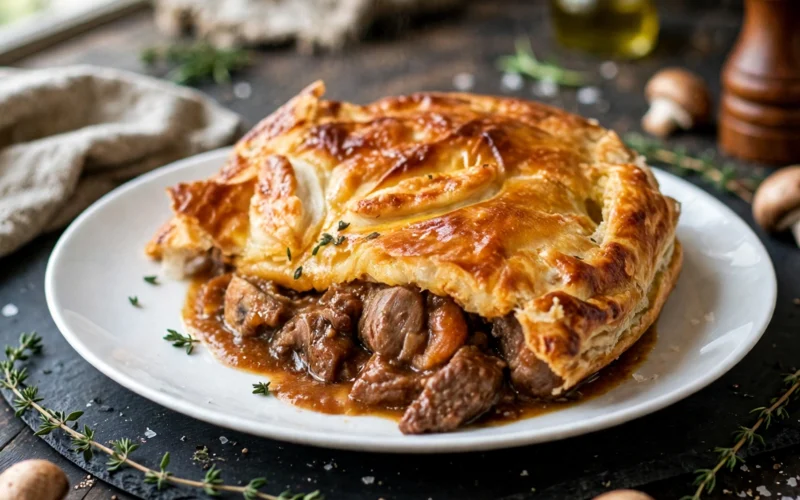
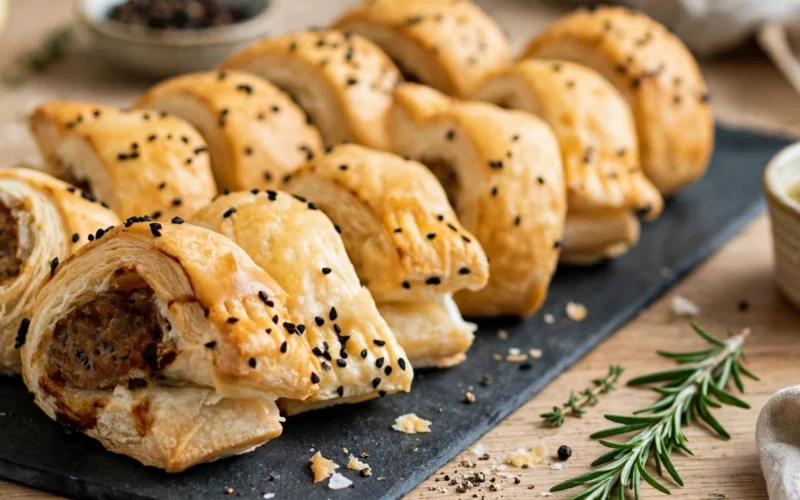
The recipe ends at chilled dough, so bake to the recipe you are using it for. Tesco suggests sausage rolls, cheese straws and a tarte tatin. One baking site puts the usual oven range for puff pastry at about 200°C (400°F), but says it depends on the recipe. Leiths notes that shop-bought puff generally rises higher and more evenly than homemade, so for some recipes you may need to roll the homemade version thinner.
Nutrition (estimate)
About 2,733 kcal for the whole batch. That is roughly 390 kcal per 100g if the batch weighs 700g, or 420 kcal if it weighs 650g. It is built from Tesco label values:
| Ingredient | kcal |
|---|---|
| Strong white flour 250g (348 kcal per 100g) | 870 |
| Unsalted butter 250g (745 kcal per 100g) | 1,863 |
| Total | 2,733 |
Salt and water add no calories. I haven’t set a portion size because it depends on what you make. As a check, The Essential Guide To’s puff pastry uses the same 250g of flour and 250g of butter, makes 640g and lists 431 kcal per 100g. My total divided by 640g is 427 kcal, within 1% of that figure. It is a different recipe, so this is a sense-check, not a match.

Gordon Ramsay Rough Puff Pastry (Puff Pastry Recipe)
Rough puff pastry from equal weights of strong flour and butter, rubbed in loosely and given two folds. Based on Gordon Ramsay's recipe in Just Desserts. Makes about 700g.
Ingredients
Tap to tick offMethod
-
Sift the flour and salt into a large bowl. Break the butter into small chunks and rub it in loosely with your fingertips, stopping while you can still see pieces of butter.
-
Make a well and pour in about two-thirds of the 150ml of water. Mix to a firm, rough dough, adding more water only if needed.
-
Cover with cling film and chill for 20 minutes.
-
Tip onto a lightly floured surface, knead gently and shape into a smooth rectangle.
-
Roll in one direction only to about 20 x 50cm, keeping the edges straight and the butter showing as streaks.
-
Fold the top third down to the centre and the bottom third up over it. Give a quarter turn, roll out to three times the length again and fold the same way.
-
Cover and chill for at least 20 minutes before rolling out for use.
Recipe notes
Contains gluten (wheat) and milk. Check your brands. Not gluten-free or dairy-free. This recipe makes dough only, so follow the recipe you are using it in for oven temperature and time. Do not eat the dough raw. Keep in the fridge for up to 2 days, or freeze well wrapped for up to 1 month; defrost in the fridge, use within 24 hours and do not refreeze. Calories are an estimate from Tesco label values for flour and butter.

2 Comments